
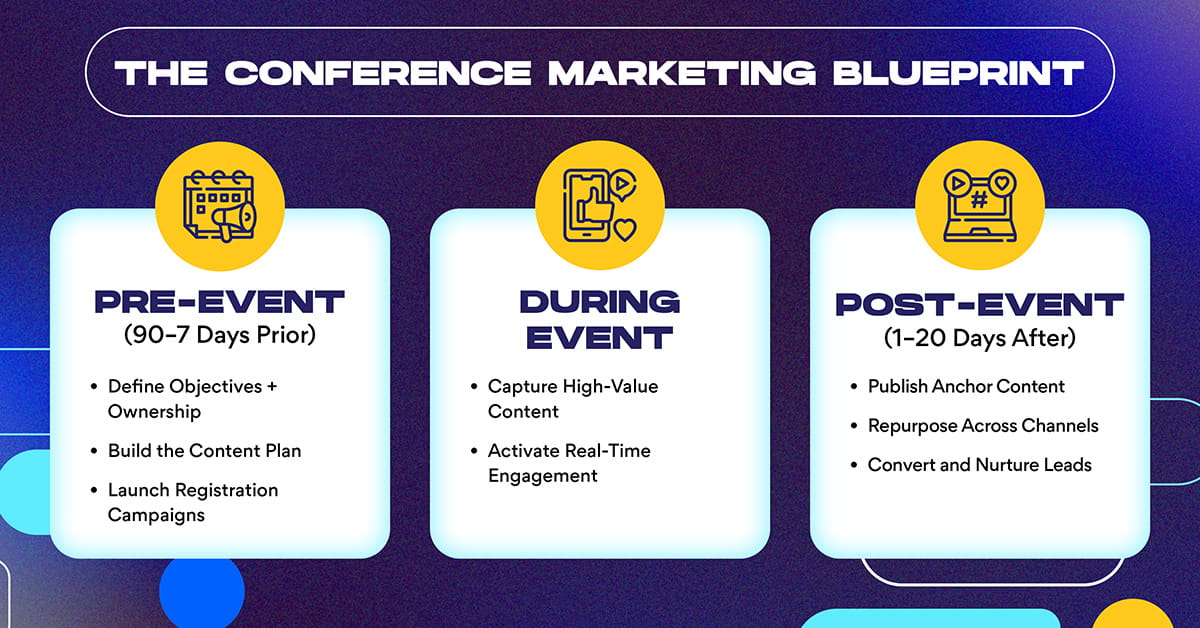
Most professional associations and advocacy organizations treat conference marketing as a 72-hour sprint. That approach leaves measurable value on the table.
This blueprint starts before the tactics — with the team structure and strategic objective decisions that determine whether execution succeeds. It then covers eight high-impact actions across the full event lifecycle, from 90 days out to 20 days post-event, to turn a single conference into a months-long lead generation and community-building asset.
Registration numbers matter. So do attendance rates, sponsor satisfaction scores, and post-event survey completions. But if your event marketing strategy begins the week of the event and ends the day after, you are measuring the wrong things.
The organizations producing the most durable conference value — associations including the National Black MBA Association (NBMBAA), the The Executive Leadership Council (ELC), and the National Society of Black Engineers (NSBE) — treat their annual events as content and community infrastructure. Each conference generates assets that drive membership growth, sponsor ROI, and public visibility for 12 months after the closing reception.
Before the Blueprint: Two Decisions That Determine Outcomes
The eight actions in this blueprint are only as effective as the foundation they are built on. Before timelines, hashtags, or capture teams enter the conversation, two decisions need to be made and documented. Skipping them is the most common reason well-resourced events still produce underwhelming marketing results.
Decision 1: Lock Your Team Structure Before You Lock Your Date
Unclear ownership is the single most common reason conference content underperforms. When the person responsible for session logistics is also expected to manage social media, run the hashtag, and brief the photographer, none of those functions get done well. Defining roles — and deciding whether agency support is needed — should happen at the same time the event date is confirmed, not three weeks before.
The question is not “do we have enough people.” The question is “do we have the right people in the right roles with clear decision-making authority.”
Recommended team structure for a mid-to-large conference (500+ attendees):
| Role | Internal or Agency | Primary Responsibility |
|---|---|---|
| Marketing / Comms Lead | Internal | Overall strategy, approvals, sponsor reporting, final sign-off on all published content |
| Single Point of Contact (POC) | Internal | Day-to-day liaison; owns the approval workflow and timeline |
| Content Capture Lead | Agency (recommended) | On-site video and photo capture, shot list execution, same-day asset delivery |
| Social Media Curator | Internal or Agency | Real-time hashtag monitoring, UGC curation, social wall moderation, live posting |
| Email and CRM Manager | Internal or Agency | Pre-event sequences, post-event nurture flows, list segmentation, performance reporting |
| Creative / Design Support | Agency (recommended) | Speaker spotlight graphics, event branding, post-event recap templates, impact report layout |
Agency engagement timing matters. Organizations that bring in a content capture team or marketing agency at 90 days out consistently produce more usable pre-event content, cleaner on-site operations, and faster post-event turnaround than those that engage at 30 days. The difference is lead time.
Black Digital has supported this model at scale — for the ELC’s Men in Leadership conference, the team secured 2x the registration goal and earned a 2023 Communicator Award of Excellence. For ELC Week social media campaigns, Black Digital grew ELC’s LinkedIn following to 200,000+ through strategic video content and sustained social management.
Decision 2: Set Your Marketing Objective, Not Just Your Attendance Goal
Attendance targets are operational benchmarks. Marketing objectives determine strategy. They are not the same thing, and conflating them produces campaigns that fill seats without advancing organizational goals.
Before any content is planned, the communications lead should answer: what is this event’s primary marketing purpose this year?
- Member retention and re-engagement: The event is the proof point that membership has tangible value. Content should emphasize community, access, and exclusivity.
- New audience acquisition: The event is a public-facing signal. Content should be optimized for reach, shareability, and first impressions.
- Sponsor visibility and ROI demonstration: The event is a delivery vehicle for sponsor commitments. Content should document activations, audiences reached, and brand exposure metrics.
- Thought leadership positioning: The event is the organization’s most visible platform. Content should capture and amplify the intellectual output of speakers and sessions.
Most conferences serve more than one purpose. That is fine — but the primary objective should be ranked, agreed upon, and documented before content planning begins. It determines which metrics matter, which content gets prioritized on-site, and how the post-event impact report is framed.
Conference Content Timeline: Months 1–6
Most event teams compress marketing into the final 30 days. The organizations that outperform peers start earlier and work a system, not a calendar.
| Phase | Timeframe | Primary Actions |
|---|---|---|
| Pre-Event | Months 1–3 | Announce speakers, launch FOMO email sequence, publish speaker spotlights, establish event hashtag, build social wall |
| Pre-Event | Month 4–6 weeks out | Activate UGC prompts, schedule teaser content, brief on-site capture team, confirm approval workflows |
| During Event | Day 1–3 | Real-time storytelling, iPhone capture, hashtag monitoring, live social wall, session quote graphics |
| Post-Event | Days 1–7 | Distribute session highlights, publish recap content, send sponsor performance reports |
| Post-Event | Days 8–20 | Release impact report, activate lead nurture sequence, repurpose long-form video into short-form clips |
Phase 1: Pre-Event
1. Build Community Before Day One With Speaker Spotlights
Registration is a transactional milestone. Community is what converts a first-time attendee into a multi-year member.
Speaker spotlight content — short Q&As, 60-second video clips, or single-insight pull quotes — does three things simultaneously: it provides credibility for undecided registrants, gives confirmed attendees a reason to share before the event, and seeds the algorithm with keyword-rich content that extends organic reach.
Production note: Speaker spotlight assets do not require a film crew. A well-framed iPhone video with a branded graphic frame and a strong pull-quote overlay performs comparably to produced video on LinkedIn and Instagram. Black Digital’s capture approach for ELC Week and the NBMBAA national conference used this model to generate speaker content at scale without extending production timelines.
2. Deploy a FOMO Email Sequence, Not a Blast Calendar
A FOMO sequence is a structured, behavior-triggered email series designed to move undecided prospects to registration and already-registered attendees toward full engagement. According to the M+R Benchmarks 2025 report, fundraising emails generated $58 per 1,000 messages — and event-specific sequences, when personalized, consistently outperform general organizational email sends.
A high-performing pre-event sequence includes:
- A “why this year matters” anchor email at 8 weeks out
- A speaker-driven “don’t miss this session” email at 4 weeks out
- A logistics and agenda preview at 2 weeks
- A final “last call” with social proof (attendee count, featured names) at 5–7 days out
Each email should have one primary action, a measurable click target, and tracking parameters that feed into your post-event attribution report.
3. Establish the Hashtag and Social Infrastructure Early
A hashtag announced the week of the event is a missed opportunity. Organizations that launch their event hashtag 6–8 weeks in advance build a searchable archive that amplifies reach before, during, and after the conference.
According to research aggregated by VenuIQ, posts with branded hashtags achieve 2.5 times greater engagement than those without. At NSBE national conventions, real-time social walls positioned near registration and main-stage areas drove measurable increases in attendee posting behavior and extended the event’s organic reach across platforms.
The Walls.io 2026 Event Engagement Index found that 60.8% of attendees engage through event screens and live displays. A social wall is a participation mechanism, not just a tracking tool.
Practical setup: Tools like Walls.io or Tagboard aggregate tagged content across platforms in real time. Assign one team member to moderation during the event. Establish approval criteria in advance.
Phase 2: During the Event
4. The Real-Time Storytelling Model
Real-time event storytelling is not live tweeting. It is a structured content operation with clear roles, a defined capture list, and an approval workflow that allows for same-day publication.
Dr. Josie Ahlquist, a digital leadership researcher and three-time LinkedIn Top Voice in Education, has documented that the events generating the most durable online engagement treat content capture as a scheduled function — not a reaction to what happens to be interesting in the room.
The operational framework:
- Assign a dedicated capture lead whose only job is content, not logistics
- Build a shot list before the event (keynote moments, networking scenes, sponsor activations, award ceremonies)
- Establish a shared folder or Slack channel for same-day asset handoff
- Set a 2-hour publication window for all captured content
5. iPhone Footage as a Production Strategy
Produced video has its place. But for the volume of content a 3-day conference requires, iPhone footage — shot with intentionality and a minimal kit — outperforms produced video in three measurable ways: turnaround time, platform-native performance, and audience relatability.
The minimum viable capture kit: iPhone with a stabilizer gimbal, a directional lapel mic, a portable LED panel, and a branded lower-third graphic template. With this setup, Black Digital’s capture teams have delivered same-day highlight reels for the CEEJH Symposium and ELC Week that averaged 3x the organic reach of pre-produced promotional content.
6. Curate UGC — Don’t Just Collect It
User-generated content submitted via event hashtags is a trust signal, not free creative. The difference between UGC that builds credibility and UGC that creates noise is curation.
According to Nosto’s UGC research, UGC posts see 28% higher engagement than brand-generated posts, and social campaigns incorporating UGC see a 50% lift in engagement overall.
Designate a social curator who monitors the hashtag feed in real time, selects posts that reflect the event’s positioning, and amplifies them through the official account. This drives additional posting behavior from attendees who want to be featured, compounding reach without additional ad spend.
Phase 3: Post-Event
7. The 20-Day Rule: Keep the Momentum Alive
Most event organizations experience a sharp drop in engagement on Day 2 post-event. The 20-Day Rule is a content release schedule designed to extend the event’s visibility window.
| Days | Content Type | Distribution Channel |
|---|---|---|
| 1–3 | Session highlight clips (60–90 sec) | Social, email to attendees |
| 4–7 | Speaker quote graphics, recap blog post | Web, LinkedIn, email newsletter |
| 8–14 | Long-form session recaps, sponsor thank-you content | Web, sponsor-facing report |
| 15–20 | Impact report release, “what’s next” teaser content | Email, press, member communications |
According to Bizzabo’s event marketing data, 63% of webinar views are on-demand replays watched after the live event. Post-event content does not just recap what happened — it introduces new audiences who missed it.
8. Impact Reporting: The Asset That Funds Next Year’s Event
Impact reporting is not a post-event survey summary. It is a structured document that demonstrates the measurable outcomes of the event to three audiences: attendees, sponsors, and leadership.
A well-structured impact report includes:
- Total reach: attendee count, social impressions, media coverage
- Content performance metrics: views, engagement rate, click-through on email
- Sponsor activation outcomes: booth traffic, lead captures, co-branded content
- Session-level attendance and engagement data
- Qualitative highlights: notable speakers, key decisions made, community milestones
Organizations that move beyond “dollars raised” and “attendance count” in their post-event reporting — specifically those that document community reach, media impressions, and constituent outcomes — see measurably higher sponsor renewal rates and board investment in future events.
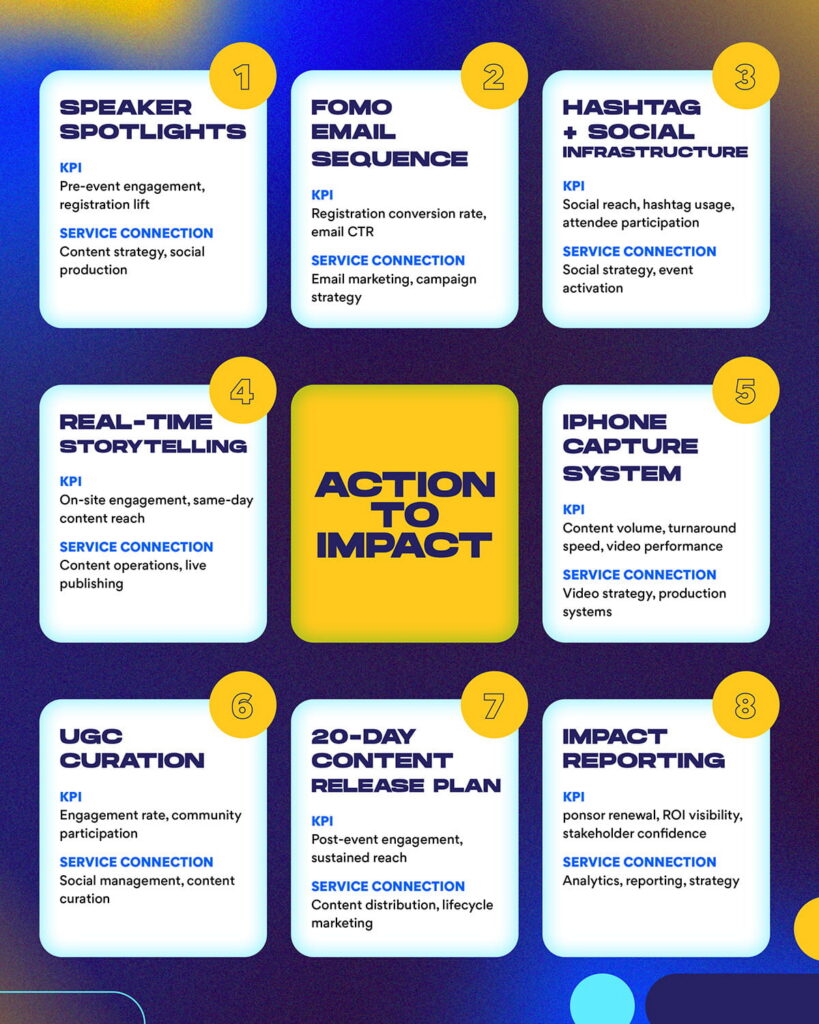
How These 8 Actions Connect to Measurable Outcomes
| Action | Primary KPI | Service Connection |
|---|---|---|
| Speaker spotlights | Pre-event social reach, registration conversion lift | Content capture + creative design |
| FOMO email sequence | Email open rate, registration completions | Marketing strategy + lead generation |
| Hashtag + social wall | UGC volume, organic impressions | Social media management |
| Real-time storytelling | Same-day engagement rate | On-site capture squad |
| iPhone footage | Short-form video views, shares | Content engines + video repurposing |
| UGC curation | Attendee posting volume, reach amplification | Social media management |
| 20-day release schedule | Post-event traffic, member retention signals | Content repurposing + branding |
| Impact report | Sponsor renewal rate, board investment | Reporting + agency governance |
Frequently Asked Questions
When should we bring in an agency or external capture team?
At the same time you confirm your event date — ideally 90 days or more in advance. Organizations that engage agency support at 30 days consistently receive less usable pre-event content, experience more on-site production issues, and deliver slower post-event turnaround. Lead time is the variable most within your control.
How do we define our marketing objective before planning begins?
Ask one question: what does a successful event look like for the organization beyond headcount? If the answer is member retention, sponsor ROI, new audience acquisition, or thought leadership positioning, that becomes the primary objective. Document it and share it with every team member and agency partner before content planning starts.
How far in advance should conference marketing planning begin?
90 days is the operational floor for organizations that want to execute a full pre-event content sequence. The speaker spotlight and hashtag strategy should be active by 60 days out.
What is the minimum viable team for on-site content capture?
Two dedicated roles: a capture lead (responsible for video and photo) and a social manager (responsible for real-time publishing and UGC curation). Logistics and programming staff should not be reassigned to these functions.
How do we measure ROI on conference content?
Track reach (impressions + attendee count), engagement (likes, shares, click-throughs), and conversion (email sign-ups, membership renewals, sponsor inquiry volume) across a 20-day window post-event. Benchmark against the prior year’s event.
What makes an impact report different from an event recap?
An event recap summarizes what happened. An impact report quantifies outcomes against stated objectives and presents findings in a format suitable for board review and sponsor renewal conversations.
Should we build a social wall for every conference?
Social walls perform best at events with 500+ attendees where on-site screen placement is feasible. For smaller events, a dedicated hashtag with active curation achieves comparable UGC amplification.
How long should post-event content be released?
20 days is the standard window for sustained engagement. Beyond that, content transitions from event-driven to thought leadership and should be repositioned accordingly.
What is the COPE method and how does it apply to conference content?
COPE stands for Create Once, Publish Everywhere, a framework originating at NPR in 2009. A 45-minute keynote can be repurposed into a 90-second highlight reel, a 10-quote graphic series, a 600-word blog post, and a 3-email nurture sequence — all from a single production investment. See how Black Digital applies COPE through our Content Marketing Strategy services.
When should we hire an on-site capture team versus using internal staff?
If your event produces content used in sponsor reports, membership materials, or paid promotion, hire a dedicated capture team. Internal staff managing logistics cannot consistently produce publication-ready assets.
Ready to Build a Conference Marketing System That Compounds
Black Digital works with professional associations, nonprofits, higher education institutions, and mission-driven organizations to build the marketing infrastructure that turns annual events into year-round content and community assets.
If your organization is producing events without a pre-event content strategy, walking away with one recap video, or reporting on attendance without measuring the downstream content impact, we can help you build the system.
Schedule a free 30-minute strategy conversation. We will review your current event marketing approach, identify where value is being left behind, and outline what a full-cycle conference marketing program would look like for your organization.