

Your organization just spent $50,000 producing an event. You have a recap video. That’s it.
Most organizations walk away from their highest-investment moments with a single polished video, a few social posts, and a folder of photos no one will ever use again. The speakers were sharp. The panels were substantive. The room was full of insight. And almost none of it made it past the event itself.
The organizations that consistently dominate their sector’s digital channels are not producing more original content than their peers. They are extracting more value from content they already own. Every conference you host, every summit you convene, every gala you produce is a content asset waiting to be activated. Most of it is going to waste.
The “One Recap Video” Mistake
The default event content strategy looks like this: hire a videographer, capture b-roll and speaker clips, produce a two-minute highlight reel, post it once, and move on.
This approach treats events as one-time communications moments rather than content production opportunities. The result is a significant return gap: thousands of dollars invested in an event, and one asset produced.
The problem is not the recap video. The problem is that it is the only asset.
A 90-minute keynote contains dozens of extractable insights. A panel discussion generates multiple distinct arguments that can each stand alone as short-form content. A fireside chat produces at least three to five quotable moments your audience has never seen — and that no other organization in your space is publishing.
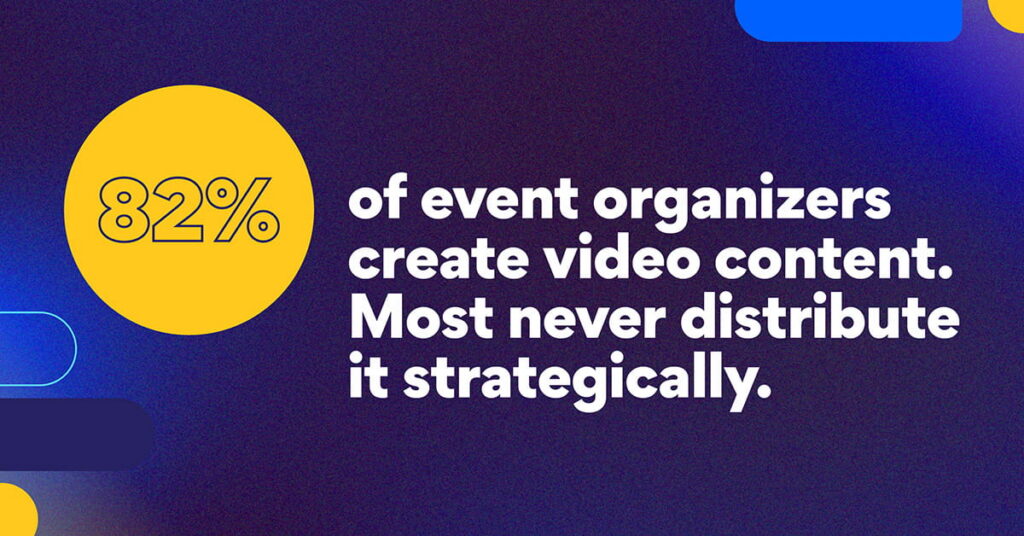
According to Bizzabo’s 2026 Event Marketing Statistics report, 82% of event organizers create on-demand video content from their events, but only 53% gate it or distribute it strategically. The content is being captured. The system to extract value from it rarely exists.
What “On-Site Capture” Actually Means
Most event videographers are hired to document what happened. That is a fundamentally different brief than capturing what matters.
Documentation produces archives. Strategic capture produces assets.
The distinction comes down to the brief you give before the event. Organizations with effective content engines do not send a videographer to “cover the event.” They deploy a capture team with a specific shot list built around impact moments:
- Moments where a speaker states a counterintuitive claim
- Moments where an audience member asks a question that reflects a widespread concern
- Moments where a panelist gives a direct, quotable answer
- Transitions, reactions, and behind-the-scenes footage that humanizes the work
The single most valuable change you can make to your event content strategy is to assign one person — staff or contractor — whose only job is to identify and flag “extract this” moments in real time.
This person is not the photographer. Not the AV team. This is a content-aware operator who understands what your audience needs to see and can identify it as it happens.
Black Digital has deployed this model at events including ELC Week and the NBMBAA annual conference — producing same-day social assets while building a content bank that extended organizational visibility for weeks after the event closed.
The Content Multiplier: One Event, Three Months of Assets
Here is what a disciplined event content engine produces from a single two-day conference. These figures reflect practitioner estimates based on documented workflows; asset counts will vary by event scale and team capacity.
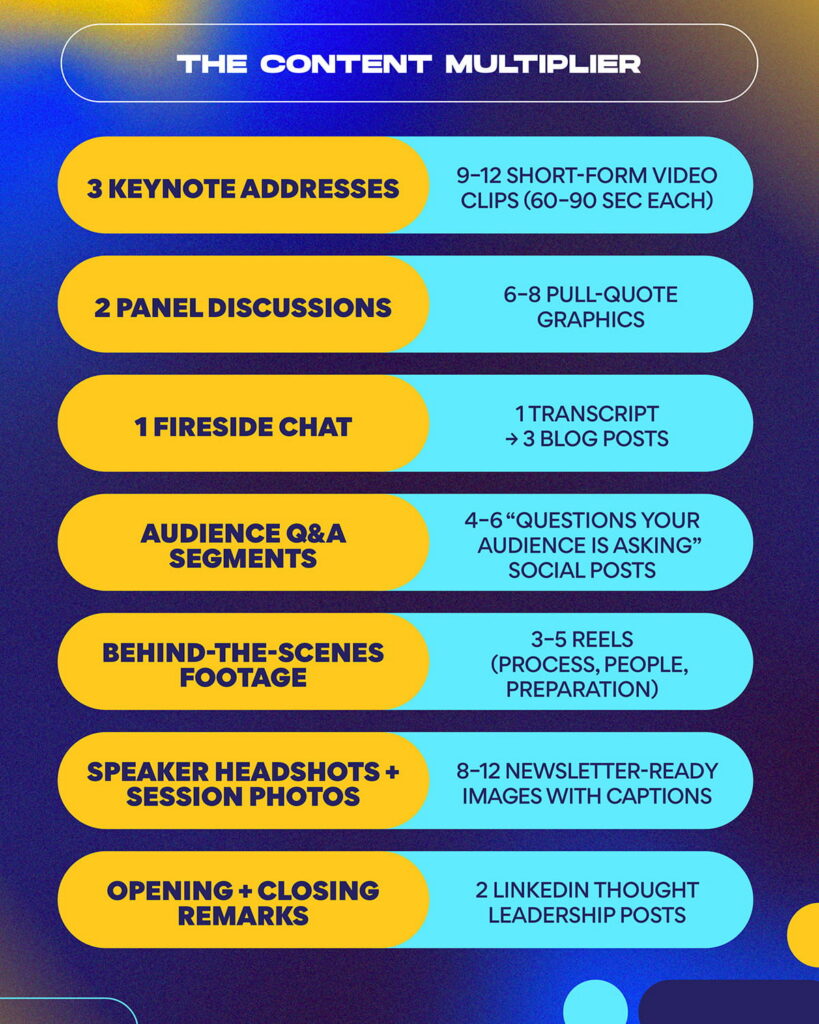
| Source Material | Extracted Assets |
|---|---|
| 3 keynote addresses | 9–12 short-form video clips (60–90 sec each) |
| 2 panel discussions | 6–8 standalone pull quotes formatted as graphics |
| 1 fireside chat | 1 long-form transcript → 3 blog posts |
| Audience Q&A segments | 4–6 “questions your audience is asking” social posts |
| Behind-the-scenes footage | 3–5 humanizing reels showing process, people, and preparation |
| Speaker headshots + session photos | 8–12 newsletter-ready images with captions |
| Opening and closing remarks | 2 LinkedIn thought leadership posts attributed to leadership |
That is a conservative range. Organizations with a documented extraction workflow regularly produce enough assets to sustain a consistent publishing cadence for 10–12 weeks without generating a single piece of original content. According to content repurposing research cited by Intero Digital, repurposing strategies improve content ROI by 32% on average — and organizations that update and republish existing content grow organic traffic by up to 106%.
From Event to Evergreen: The Extraction Workflow
Capturing content is step one. Extracting and publishing it on a schedule is where most organizations stall. The work sits in a Dropbox folder until it becomes irrelevant.
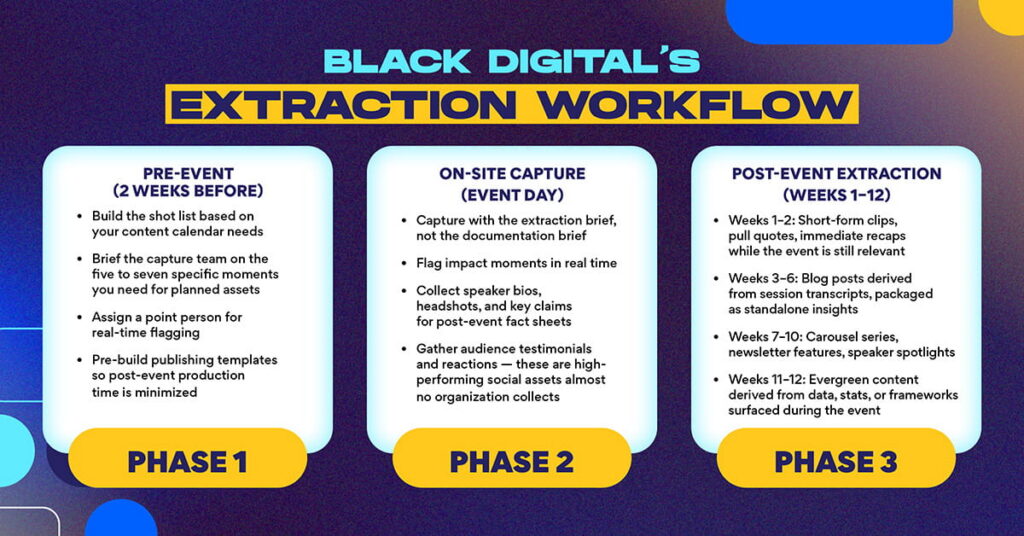
A functional event content engine has three phases.
Phase 1: Pre-Event (2 weeks before)
- Build the shot list based on your content calendar needs
- Brief the capture team on the five to seven specific moments you need for planned assets
- Assign a point person for real-time flagging
- Pre-build publishing templates so post-event production time is minimized
Phase 2: On-Site Capture (Event day)
- Capture with the extraction brief, not the documentation brief
- Flag impact moments in real time
- Collect speaker bios, headshots, and key claims for post-event fact sheets
- Gather audience testimonials and reactions — these are high-performing social assets almost no organization collects
Phase 3: Post-Event Extraction (Weeks 1–12)
- Weeks 1–2: Short-form clips, pull quotes, immediate recaps while the event is still relevant
- Weeks 3–6: Blog posts derived from session transcripts, packaged as standalone insights
- Weeks 7–10: Carousel series, newsletter features, speaker spotlights
- Weeks 11–12: Evergreen content derived from data, stats, or frameworks surfaced during the event
The key is scheduling extraction before the event, not after. When extraction is reactive, it competes with the next campaign. When it is pre-scheduled, it runs on its own track.
Short-Form Video: No Longer Optional
Organizations that still treat short-form video as a “nice to have” are losing ground to peers who have made it the center of their distribution strategy.
According to Rival IQ’s 2025 Social Media Industry Benchmark Report, which analyzed more than 4 million posts across 9 billion interactions, nonprofits achieved above-median engagement on all social channels, with Reels outperforming all other post types on Instagram. Short-form video — 30 to 90 seconds, vertical format, published natively on LinkedIn, Instagram, and YouTube Shorts — consistently outperforms static graphics and long-form content in reach, engagement, and new audience acquisition.
Your event produces this content naturally. The challenge is capture and packaging, not creation.
A 90-second clip of your Executive Director responding to a sharp audience question will reach more of your target audience than a two-minute highlight reel — because it answers a specific question, it is skimmable, and the algorithm rewards the completion rates short-form content consistently achieves.
Speaker Content: The Underused Asset
Event speakers are content partners. Most organizations treat them as event-day talent and miss the extended value entirely.
When a recognized expert speaks at your conference, they bring built-in credibility and audience reach. Every clip you produce from their session can be shared by them, tagged to them, and cross-posted to their networks — extending your reach to audiences you have not yet earned.
This requires one thing: a post-event speaker content kit.
A speaker content kit includes three to five ready-to-post clips from their session, formatted for LinkedIn and Instagram, with suggested captions they can use without modification. Most speakers will post content from their session if you make it frictionless. Almost none will if it requires editing, reformatting, or caption writing.
According to UGC research from Nosto, social posts that incorporate shared content from trusted voices see 28% higher engagement than brand-only posts. Speaker amplification is the closest equivalent organizations have to earned media from a single event.
The organizations that close this gap produce more content, reach more people, and build stronger speaker relationships — all from content they already own.
The iPhone Capture Protocol: What Staff Can Do Right Now
You do not need a full production team to begin building an event content engine. A disciplined staff member with a modern smartphone and a clear brief can produce high-performing content assets.
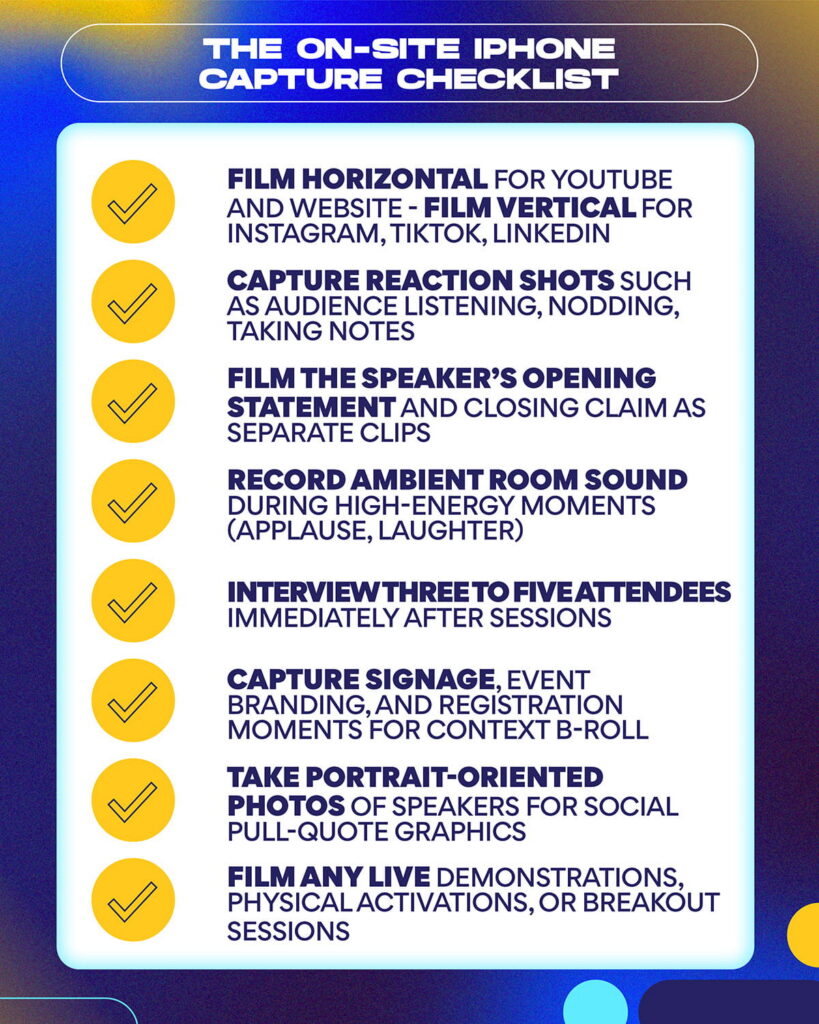
The On-Site iPhone Capture Checklist:
Film horizontal for YouTube and website; vertical for Instagram, TikTok, LinkedIn
Capture reaction shots: audience listening, nodding, taking notes
Film the speaker’s opening statement and closing claim as separate clips
Record ambient room sound during high-energy moments (applause, laughter)
Interview three to five attendees immediately after sessions (“What’s one thing you’re taking back to your organization?”)
Capture signage, event branding, and registration moments for context b-roll
Take portrait-oriented photos of speakers for social pull-quote graphics
Film any live demonstrations, physical activations, or breakout sessions
For high-priority events, professional capture is still the standard. This checklist is the baseline that ensures no high-value moment goes undocumented.
Why This Does Not Happen
If the return on event content extraction is this clear, why do most organizations still walk away with a single recap video?
Three reasons, all structural.
Capacity.
Communications teams are stretched. Post-event extraction competes with the next campaign, the next deadline, the next crisis. Without a dedicated extraction workflow, it does not happen. According to the Nonprofit Marketing Guide’s 2025 Trends Report, only 17% of communications teams grew in 2025 — yet output expectations expanded across every channel.
Brief clarity.
Most videographers are not content strategists. They deliver what they were asked for (documentation) because no one gave them an extraction brief. The brief is the system.
No publishing infrastructure.
Even when content is captured, it sits unformatted in a shared folder because there are no pre-built templates, no publishing schedule, and no assigned owner.
These are solvable problems.
They require process, not budget. And they compound over time: organizations that build the system in year one extract value from every event for years.
What This Looks Like in Practice
A mid-size professional association hosts its annual two-day conference. Attendance: 400. Speakers: 12.
Without a content engine, the output is a recap video, 40 photos, and a “save the date” for next year.
With a content engine, the same event produces: 14 short-form clips distributed over six weeks, six speaker spotlight posts shared by the speakers themselves, three blog posts derived from session transcripts and published as search-optimized thought leadership, two email newsletter features using attendee reaction quotes, and one evergreen “top insights from our 2025 conference” piece that drives search traffic for 18 months.
The second organization does not spend more on content. It spends the same on the event and more on extraction. The return is multiplicative.
Black Digital has executed this model for organizations including ELC’s Men in Leadership conference — securing 2x the registration goal while producing event content that extended campaign visibility well past closing day.
The Infrastructure Required
Building an event content engine does not require new headcount. It requires:
- A documented shot list template built around your content calendar
- A post-event extraction schedule with assigned owners and deadlines
- Pre-built publishing templates for the five to seven asset types you produce most
- A speaker content kit workflow that delivers assets within 72 hours of the event
- A short-form publishing cadence that begins the week the event ends
This is infrastructure, not creativity. Once it exists, it runs with minimal oversight and produces compounding returns across every event you host.
Frequently Asked Questions
How many content assets can one event realistically produce?
For a two-day conference with three keynotes, two panels, and one fireside chat, a disciplined extraction workflow can produce between 30 and 60 discrete assets: video clips, pull-quote graphics, blog posts, email features, newsletter images, and social posts. The range depends on team capacity and production quality. Even without a dedicated team, a two-person operation following a structured extraction workflow can produce 20–30 assets from a single event.
What is the COPE method and how does it apply to conference content?
COPE stands for Create Once, Publish Everywhere, a content production framework originated at NPR by Daniel Jacobson in 2009. Applied to events, it means treating every keynote, panel, and interview as a source file — not a finished product. A 45-minute session becomes a 90-second highlight reel, a 10-quote graphic series, a 600-word blog post, and a three-email nurture sequence, all from a single production session. Learn more about how Black Digital applies COPE to content strategy on our Content Marketing Strategy page.
When should we hire an on-site capture team versus using internal staff?
If your event produces content used in sponsor reports, membership materials, or paid promotion, hire a dedicated capture team. Internal staff managing logistics cannot consistently produce publication-ready assets. For smaller events where the output is organic social only, a trained staff member with an iPhone and a clear brief can handle capture effectively.
How do we get speakers to actually share their content kits?
Make it frictionless. Deliver the kit within 72 hours of the event while the experience is still fresh. Include formatted clips ready to post without editing, suggested captions they can copy and paste, and a brief note explaining why sharing benefits them. The more work you do upfront, the higher the share rate.
What is the minimum viable content output from a single event?
At minimum: one short-form video clip, one pull-quote graphic, and one written recap. These three assets can be produced in two to three hours post-event and sustain a week of publishing. The goal is to establish the habit and infrastructure — volume follows once the system is in place.
How do we handle content featuring attendees or participants who have not signed a release?
Obtain release permissions at registration or check-in with a simple digital form. For on-site interview footage, collect verbal and digital consent before filming. Any footage published to public channels without documented consent creates liability. Build the release process into your event registration workflow, not as an afterthought on the day.
Ready to Turn Your Next Event Into a Content Engine
Black Digital works with nonprofits, professional associations, higher education institutions, and mission-driven organizations to build event content systems that produce consistent output long after the venue clears.
If your organization hosts two or more events per year and is not operating a structured content extraction workflow, the gap between your current output and your potential output is significant. We can audit your last three events, identify what was left on the table, and build the infrastructure to capture that value going forward: on-site capture, speaker content kits, and a post-event publishing system.
Schedule a free 30-minute content strategy conversation. We will review your current event content approach, identify where value is being lost, and outline what an event content engine would look like for your organization.