
Most marketing teams are not understaffed. They are overextended.
The pressure to maintain a presence on every channel — LinkedIn, Instagram, TikTok, Facebook, YouTube, X — without a corresponding increase in budget or headcount is one of the most common drivers of content fatigue, inconsistent posting, and declining engagement. According to HubSpot’s 2025/2026 Marketing Statistics report, 65% of marketing professionals report that consumers are fatigued by generic AI-generated content, and 56% say the internet is now flooded with undifferentiated output.
The answer is not more content. It is a more disciplined channel selection framework.
The “Presence Everywhere” Paradox
The assumption that visibility requires volume is operationally unsustainable and strategically counterproductive.
An active presence on every platform does not build authority. It dilutes it. When your team stretches content across six channels without a clear audience rationale, you produce content generic enough to post anywhere but specific enough to perform nowhere.
The organizations with the highest organic engagement are not posting the most. They are posting with the most precision.
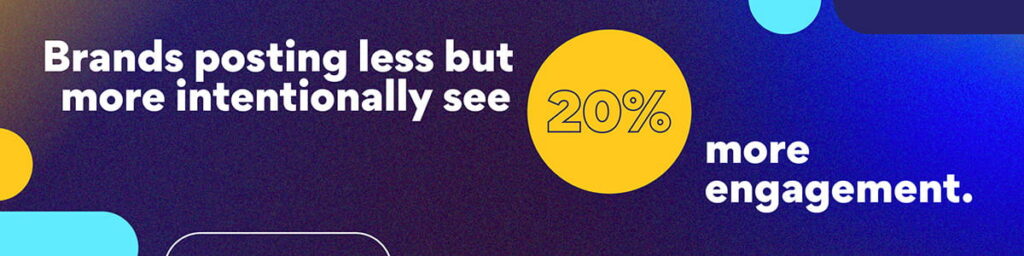
According to Sprout Social’s 2025 reporting, brands that post less but with greater intentionality see 20% more engagement than those posting at high volume. For nonprofits, where communications teams are already stretched, this is a strategic and operational permission slip: do fewer things, better.
Black Digital’s Platform Alignment Framework holds that the highest-performing nonprofit and higher education marketing teams maintain deep presence on two to three platforms and deliberately ignore the rest. The result is higher engagement rates, reduced production overhead, and clearer attribution between content investment and audience action.
Audience-Platform Fit: Match Channel to Decision Behavior
The most important question before choosing a platform is not “Where is everyone?” It is “Where does our specific audience make decisions?”
Platform selection should be driven by audience intent, not platform popularity.
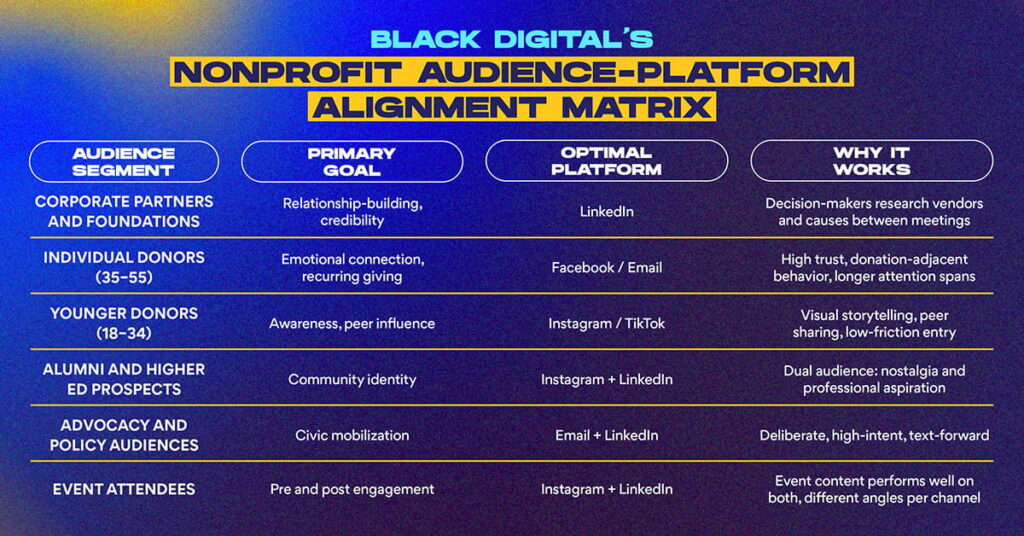
Black Digital’s Nonprofit Audience-Platform Alignment Matrix:
| Audience Segment | Primary Goal | Optimal Platform | Why It Works |
|---|---|---|---|
| Corporate partners and foundations | Relationship-building, credibility | Decision-makers research vendors and causes between meetings | |
| Individual donors (35–55) | Emotional connection, recurring giving | Facebook / Email | High trust, donation-adjacent behavior, longer attention spans |
| Younger donors (18–34) | Awareness, peer influence | Instagram / TikTok | Visual storytelling, peer sharing, low-friction entry |
| Alumni and higher ed prospects | Community identity | Instagram + LinkedIn | Dual audience: nostalgia and professional aspiration |
| Advocacy and policy audiences | Civic mobilization | Email + LinkedIn | Deliberate, high-intent, text-forward |
| Event attendees | Pre and post engagement | Instagram + LinkedIn | Event content performs well on both, different angles per channel |
According to Nonprofit Tech for Good’s 2026 Social Media Statistics, 93% of nonprofits use Facebook, 85% use Instagram, and 81% use LinkedIn — but engagement rates vary significantly by platform and audience type. LinkedIn delivers a 1.91% engagement rate for nonprofits, outperforming Facebook’s 0.046% by a wide margin. Instagram sits at 0.623%, but with reach of 15.3% of followers — the highest organic reach of any major platform.
Choosing the wrong platform for an audience is not neutral. It actively trains your team to produce content that underperforms, which compounds over time into the mistaken conclusion that “social media doesn’t work for us.”
A note on revenue operations alignment: Natalie Furness, founder of RevOps Automated and a recognized practitioner in revenue operations design, has documented the operational cost of misaligned tech stacks — situations where organizations invest in tools and channels that do not map to how their buyers or donors actually behave. The same principle applies to platform strategy: channel selection that ignores audience behavior creates friction across every downstream system, from CRM tagging to email segmentation to attribution reporting.
For a deeper look at platform-specific performance benchmarks, see our post on what makes a social media post go viral in 2026.
Consistency Over Volume: How to Build Topic Authority
Consistency is not about frequency. It is about reliability and relevance within a defined subject area.
Topic authority is built when an audience can predict what you will say, how you will say it, and where to find it. Unpredictable posting patterns, off-brand content, and platform-hopping all work against authority accumulation.
According to Rival IQ’s 2025 Social Media Industry Benchmark Report, which analyzed 4 million+ posts and 9 billion interactions, nonprofits achieve above-median engagement across all social channels. TikTok saw nonprofit follower counts grow 37% in 2024, per M+R Benchmarks 2025. But in both cases, the organizations driving outsized results are those posting with topic focus and platform-specific intent — not those posting frequently across all channels.
Black Digital’s One Month of Content in One Day System
This is Black Digital’s production model for lean marketing teams. It applies the COPE methodology (Create Once, Publish Everywhere) to batch content production.
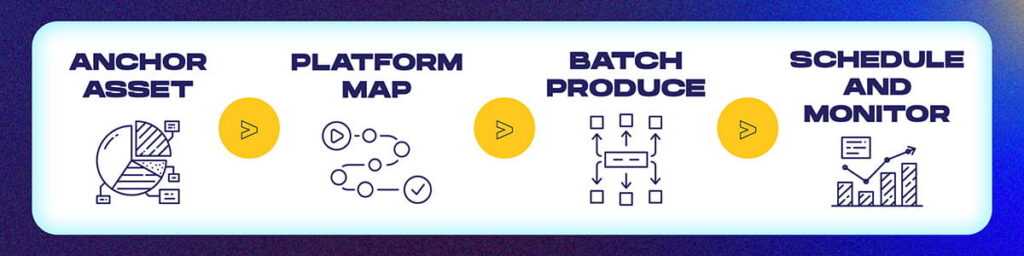
Step 1: Identify one anchor asset per month (blog post, webinar, report, event recap, case study). This becomes the source material for all downstream content.
Step 2: Map derivative formats by platform before production begins.
| Source Asset | LinkedIn Derivative | Instagram Derivative | Email Derivative |
|---|---|---|---|
| Blog post | 3-panel carousel (key points) | Quote card + link in bio | Newsletter section |
| Webinar recording | Speaker clip (60 sec) | Behind-the-scenes still | Registration recap + replay CTA |
| Annual report | Data callout card | Mission impact visual | Donor acknowledgment send |
| Event | Speaking moment clip | Event photo series | Post-event thank you + resource link |
Step 3: Batch produce in one session. One dedicated production day per month — not 15 minutes per day across five channels — reduces context-switching, maintains brand consistency, and creates a content inventory that can be scheduled, reviewed, and approved in a single workflow.
Step 4: Schedule and monitor, not create and monitor. Once content is batched and scheduled, your team’s weekly obligation is review and response, not creation. This is the operational unlock that prevents content fatigue.
Black Digital used this model to grow the The Executive Leadership Council’s LinkedIn following to 200,000+ through sustained, strategically sequenced social content — not volume.
Measuring What Matters
Platform alignment without measurement is positioning without accountability.
The metrics that matter are audience-specific, not platform-default. Vanity metrics — impressions, follower counts, reach — tell you how many people saw your content. Behavioral metrics — click-through rate, email opt-ins, content saves, reply rate — tell you whether your audience is acting on it.
| Platform | Meaningful KPI | What It Signals |
|---|---|---|
| Profile views converting to website sessions | Brand credibility is converting to interest | |
| Saves and shares | Content has utility or emotional resonance | |
| Click-to-open rate (CTOR) | Messaging relevance to engaged segment | |
| Link clicks, event RSVPs | Donation-adjacent and community behaviors |
According to the M+R Benchmarks 2025 Email Messaging data, nonprofits now send an average of 62 emails per subscriber annually, and fundraising emails generate $58 per 1,000 messages sent. For organizations where email drives the most measurable giving behavior, over-investing in social at the expense of email list quality is a common and costly strategic error.
Set a 90-day baseline before drawing conclusions. Algorithmic platforms reward consistency over time, and most organizations abandon a channel before it has enough performance data to evaluate honestly.
Common Mistakes That Extend Content Fatigue
Treating all platforms as equal.
Each platform has a different content contract with its audience. A 1,200-word thought leadership post that performs well on LinkedIn will fail on Instagram. Reposting identical content across platforms signals a lack of platform literacy, not efficiency.
Letting trends override strategy.
Every quarter, a new platform feature or format generates industry coverage. Before adopting a new format, ask: does our audience actually use this? If the answer requires research, it is probably no.
Building a content calendar without an audience map.
A content calendar is a production schedule. Without knowing who you are producing for and where they make decisions, it is a schedule of guesswork.
Measuring output instead of outcomes.
Number of posts published is an output metric. Donor conversion rate, program inquiry volume, and event registration are outcome metrics. Reporting output to leadership without outcome context makes marketing invisible as a business function.
Where to Start: The Platform Audit
Before adding channels, audit what you have.
For each platform your organization currently maintains, answer four questions:
- Who is the intended audience?
- What action do we want them to take?
- What is our current engagement rate (not reach)?
- What is the production cost per post?
If you cannot answer all four, the platform is habitual, not strategic.
A focused platform strategy concentrates ambition rather than reducing it. The organizations that consistently drive measurable results from content marketing made deliberate decisions about where to show up, then showed up there reliably with content built for that specific audience.
For more on building a sustainable social media presence for nonprofits, see our guide on 7 Quick and Effective Social Media Marketing Strategies for Nonprofits.
Frequently Asked Questions
How many social media platforms should a nonprofit use?
Two to three is the recommended range for most nonprofits, based on practitioner consensus and organizational capacity research. Nonprofit Tech for Good recommends selecting platforms where your specific audience is most active and where your content format naturally fits. Maintaining more channels than your team can sustain with quality output reduces performance across all of them.
Which platform drives the most nonprofit donor engagement?
Email drives the most direct giving behavior. According to M+R Benchmarks 2025, 33% of donors say email most inspires them to give. For social media specifically, LinkedIn drives the highest engagement rate for nonprofits at 1.91%, while Instagram delivers the highest organic reach at 15.3% of followers. The right platform depends on your audience segment and goal.
How often should nonprofits post on social media?
Frequency matters less than consistency and quality. Rival IQ’s 2025 benchmarks show that nonprofits posting with topic focus and platform-appropriate format outperform high-volume, cross-posted organizations. For LinkedIn, three to four posts per week is a sustainable and effective cadence. For Instagram Reels, one to two per week with strong hooks produces better results than daily posting of lower-quality content.
What is the best way to repurpose content across platforms without sounding repetitive?
Each platform requires adaptation, not just duplication. A blog post becomes a three-panel LinkedIn carousel, a quote card on Instagram, and a two-paragraph email intro — all from the same source material, each formatted for that platform’s specific audience behavior. The underlying insight travels; the format and framing change. See our guide on the COPE methodology for a full breakdown.
How do we know if a new platform is worth our time?
Run a 90-day pilot on a single channel before committing resources. Define success metrics upfront (engagement rate target, follower growth threshold, conversion action count). If the platform does not hit those metrics in 90 days, reallocate the time to a channel that is performing.
What is the biggest content strategy mistake nonprofits make?
Producing content without an audience map. Most organizations build a content calendar before answering the foundational question: who are we producing this for, and where do they make decisions? The calendar is only useful when it is structured around audience behavior, not organizational convenience.
Ready to Build a Content Strategy That Actually Performs
Black Digital works with nonprofits, associations, higher education institutions, and mission-driven organizations to build platform-aligned content strategies that produce consistent output without burning out the team responsible for it.
If your organization is posting across more channels than you can sustain, producing content that generates impressions but not action, or measuring activity without measuring outcomes, we can help you build a more focused, more effective approach.
Schedule a free 30-minute content strategy conversation. We will review your current channel mix, production workflow, and audience-platform alignment to identify where consolidation or reallocation will drive the most immediate performance improvement.