
Most organizations chasing virality are asking the wrong question. The better question is: what does it mean for your content to significantly outperform your baseline, reach the right audience, and move your organization closer to its goals? In 2026, the mechanics of organic reach have fundamentally changed. Shares and saves carry far more algorithmic weight than likes. Every major platform has shifted toward AI-driven content discovery, meaning what you post competes with content from accounts your audience has never followed. And the definition of “going viral” depends almost entirely on the size of your account, the specificity of your audience, and what outcome you are trying to drive.
What Makes a Social Media Post Go Viral Today?
This guide breaks down what high-performing social content looks like today, what the algorithms actually reward across six major platforms, and how marketing leaders at nonprofits, associations, higher education institutions, and government agencies can build a repeatable approach to organic reach that produces measurable results.
What “Viral” Actually Means Today
The word “viral” originally described the speed and breadth of content spreading beyond its origin point to people with no prior connection to the creator. That definition still holds, but the mechanism has changed.
In 2026, virality is driven primarily by algorithmic recommendation to strangers, not by followers sharing with followers. Instagram, TikTok, YouTube, and Facebook now surface content to users who have never engaged with your account. LinkedIn is expanding its interest-based feed. Facebook, long dependent on social graphs, now shows an estimated 30% or more of feed content from accounts users do not follow — and Meta CEO Mark Zuckerberg confirmed in Q1 2024 that more than 50% of what people see on Instagram specifically is now AI-recommended from accounts they do not follow.
The implication is significant: your follower count matters less than it used to. Content quality and audience fit now determine distribution.
What algorithms interpret as “quality” varies by platform, but several signals are consistently rewarded across all of them:
- Watch time and video completion rate
- Shares sent via direct message
- Saves (bookmarks and collections)
- Comment depth and back-and-forth conversation
- Immediate engagement velocity in the first 30 to 60 minutes after posting
Likes still matter, but they sit near the bottom of the signal hierarchy on most platforms. Instagram’s own confirmation in January 2025 identified sends per reach as the strongest signal specifically for reaching new (unconnected) audiences. On X, the platform’s open-sourced ranking code shows a reply carries 27 times the algorithmic weight of a like, and a thread where the original author replies to comments carries 150 times the weight.
Virality Is Relative: How to Define It for Your Organization
A nonprofit with 800 followers reaching 40,000 views on a single post has created something that outperformed its baseline by 50 times. That is viral by any meaningful measure, even if it does not trend nationally.
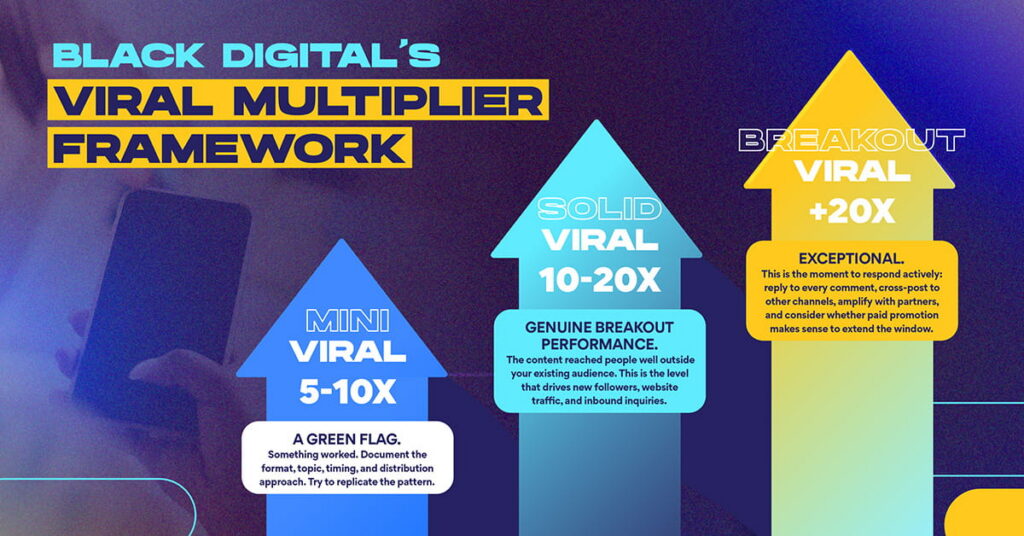
The most useful framework for mission-driven organizations uses a multiplier system against your median view or impression count across your last 30 posts:
Black Digital’s Viral Multiplier Framework:
- Mini Viral (5–10x your median): A green flag. Something worked. Document the format, topic, timing, and distribution approach. Try to replicate the pattern.
- Solid Viral (10–20x your median): Genuine breakout performance. The content reached people well outside your existing audience. This is the level that drives new followers, website traffic, and inbound inquiries.
- Breakout Viral (20x or more): Exceptional. This is the moment to respond actively: reply to every comment, cross-post to other channels, amplify with partners, and consider whether paid promotion makes sense to extend the window.
For mission-driven organizations, the more important question is what the content actually produced. Rival IQ’s 2025 Social Media Industry Benchmark Report, covering more than four million posts across 2,100 brands, found that nonprofits earn above-median engagement rates across social channels — outperforming retail, tech, financial services, and health and beauty. The audience is responsive. The challenge is usually content strategy and distribution, not lack of potential.
A post that generates 75 new event registrations matters more than a meme that earns 100,000 passive views from people who will never engage with the organization again. Define the conversion you want before you post, and measure against it.
What High-Performing Content Has in Common
Across platforms, content that consistently earns outsized reach in 2026 shares several characteristics.
It delivers complete value natively.
Every major platform now suppresses external links in feed posts. Facebook shows link posts to a fraction of followers. LinkedIn posts with links receive significantly reduced reach. The platforms want users to stay. High-performing content gives the audience what they came for without requiring a click to a third-party destination.
It earns a behavioral response.
The most reliable predictor of algorithmic amplification is whether content makes someone do something: share it with a friend, save it to return to later, leave a substantive comment, or watch it all the way through. Design every post around one of these behaviors.
It is specific and recognizable.
Generalist content competes with everything. Content that speaks directly to a nonprofit communications director, a higher-ed enrollment manager, or an association executive director has a narrower but far more engaged audience. That engagement quality sends stronger signals than broad but shallow reach.
It arrives in a consistent, recognizable format.
Algorithms treat consistency as a trust signal. Audiences do too. Organizations that establish a recurring format (a weekly insight series, a regular event recap structure, a consistent visual style) tend to build algorithmic momentum over time rather than posting spikes followed by silence.
It is original.
In 2024, Instagram officially announced that aggregator accounts reposting others’ content 10 or more times in 30 days would be removed from recommendations. That policy expanded through 2025. Instagram also detects TikTok watermarks and excludes watermarked content from Explore, Reels recommendations, and suggested content. Original creation is no longer just good practice — it is an algorithmic requirement.
Platform-by-Platform Breakdown: What Actually Works in 2026

What the algorithm rewards: Instagram’s algorithm prioritizes three primary signals: watch time on video, likes per reach, and sends per reach. DM sends function as the most powerful discovery signal for reaching new audiences. Instagram operates four separate algorithms for Feed, Reels, Stories, and Explore, meaning a single strategy does not apply across the whole platform.
Format performance: Reels achieve approximately double the reach of carousels on average, according to Social Insider’s reach analysis. But Buffer’s analysis of 4 million+ Instagram posts found carousels generate 12% more direct engagement and significantly more saves. The winning approach for most organizations: use Reels to bring in new audiences, carousels to deepen engagement with existing ones. Mixed-format carousels combining images and short video clips achieve the highest overall engagement among carousel types.
Collabs: Instagram’s Collabs 2.0, updated in October 2025, allows up to five accounts to co-author a single post or Reel. Research from Emplifi found Collab posts between related brands generate nearly double the impressions and engagement of solo posts. For associations with member organizations, nonprofits with corporate sponsors, or universities with partner institutions, this feature is one of the highest-return organic tactics available.
Best time to post: According to Sprout Social’s 2025 benchmark data, drawn from nearly 2.7 billion engagements across 463,000 profiles, Tuesday through Thursday between 11 AM and 6 PM performs consistently well. For nonprofits specifically, Sprout identifies Monday and Wednesday as the strongest days, with Wednesday at 5 PM as the standout window. Instagram Insights shows when your specific followers are most active — that data should always take precedence over general benchmarks.

What the algorithm rewards: LinkedIn’s algorithm is deliberately designed to resist viral spread in favor of professional relevance. The platform will surface posts that are two to three weeks old if they remain highly relevant to a reader’s professional context. This longer content lifespan means a well-crafted post continues working after other platforms would have buried it.
LinkedIn added saves and post sends to native analytics in September 2025 — a direct signal of what the platform plans to reward more heavily going forward. Company page organic reach has declined to approximately 1.6% of followers, per analysis of 1.8 million posts by Richard van der Blom. The implication: personal posts from executive directors, communications leads, and program staff consistently outperform brand page content.
Format performance: Buffer’s research on LinkedIn carousels found document carousel posts generate 303% more engagement than single image posts. They also achieve the highest average engagement rate of any LinkedIn format. Text posts perform best at 700–1,000 characters, with the hook before the “See More” cutoff at approximately 210 characters being the most critical real estate on the platform.
External links reduce reach substantially, with estimates ranging from 25 to 85 percent depending on format and placement, according to van der Blom’s analysis. The standard workaround is placing links in the first comment, though even this practice’s effectiveness has declined. The stronger solution: deliver complete value natively.
Best time to post: Sprout Social’s data points to 8 AM through 2 PM on Tuesday through Thursday as the strongest window. Buffer’s 2026 analysis of 4.8 million LinkedIn posts identifies Wednesday through Friday afternoons (3–8 PM) as an emerging peak, reflecting a shift in professional browsing behavior. Posting more than once within a 24-hour window causes the newer post to cannibalize the older one’s algorithmic distribution.
Callout for associations and higher ed: Document posts (slide decks, research summaries, program guides, frameworks) consistently earn the highest engagement rates on LinkedIn. For associations with proprietary research and universities with academic content, this format is a direct match to what the platform rewards and what professional audiences consume. Black Digital applied this model for the The Executive Leadership Council’s social media campaigns, helping grow ELC’s LinkedIn following to 200,000+.

TikTok
What the algorithm rewards: Unlike every other major platform, TikTok runs primarily on an interest graph rather than a social graph. Follower count has the least influence on distribution of any platform in 2026. Watch time and video completion rate account for the majority of algorithmic weighting, with shares functioning as what practitioners describe as the viral multiplier.
M+R Benchmarks 2025 documents that TikTok had the fastest-growing nonprofit audiences of any platform, with average follower counts increasing 37% in 2024. For nonprofits in early-stage platform development, this represents a growth window.
Format performance: The 15 to 30 second range consistently achieves the highest completion rates and shares. TikTok now functions as a search engine, indexing captions, text overlays, and spoken words. The Creator Search Insights tool reveals what audiences in your topic area are actively searching for, a significant strategic advantage for organizations willing to create around documented demand.
Best time to post: Sprout Social’s 2025 data identifies 5 PM through 9 PM on Wednesday through Friday as the strongest window. TikTok Studio provides viewer activity data that should override any benchmark.

YouTube
What the algorithm rewards: YouTube’s recommendation algorithm, which drives approximately 70% of what people watch on the platform, incorporates viewer satisfaction surveys alongside watch time as complementary signals. Neither alone determines distribution.
YouTube changed its Shorts view counting in March 2025: any playback of any duration now counts as a view, and each loop adds another count. Shorts and long-form content run on completely separate algorithms, meaning Shorts do not cannibalize long-form reach. Research suggests channels using both formats grow significantly faster than those using only one.
Format performance: The 15 to 30 second range remains the sweet spot for Shorts. For long-form content, the first 30 seconds are the critical retention window. Thumbnails and titles carry disproportionate weight on YouTube relative to other platforms. They are the primary driver of click-through rate, which remains a significant ranking signal.
Best time to post: Buffer’s YouTube analysis and Sprout Social’s data both support 3 PM through 7 PM on Wednesday and Friday as consistently strong windows. YouTube’s longer content shelf life means timing is less critical than on platforms like X or Instagram.

What the algorithm rewards: Meta reclassified all new Facebook video uploads as Reels on June 17, 2025. The platform launched a User True Interest Survey model in January 2026, with early data showing a 5.4% increase in high-satisfaction ratings and a 5.2% lift in total engagement.
Average organic reach on Facebook has declined to approximately 1.65% of followers for most accounts. The most consistent exception is Facebook Groups, which remain an area of strong organic reach. Meta confirmed 1.8 billion monthly active group users in October 2024. For associations with member communities, nonprofits with volunteer networks, or universities with alumni groups, Facebook Groups represent one of the last high-reach organic environments on the platform.
Format performance: Buffer’s analysis of 52 million+ Facebook posts found photos generate 35% more feed engagement than text posts and 44% more than in-feed video. Native content overwhelmingly outperforms link posts. Meta’s own Widely Viewed Content Reports show 97–98% of posts users see in their feeds contain no external link.
Best time to post: Hootsuite’s 2025 data identifies 5 AM Tuesday as an outlier peak. Sprout Social and Buffer converge on 9 AM through noon on Tuesday and Wednesday as the stronger conventional window. For nonprofits, Sprout Social identifies Tuesday through Thursday midmorning as optimal.

X (Twitter)
What the algorithm rewards: X is the most transparent of any major platform about its ranking signals, having open-sourced its algorithm (updated to a Grok-powered transformer model in January 2026). The prior open-sourced code (2023) showed a reply carries 27 times the algorithmic weight of a like, and a conversation where the original author replies carries 150 times the weight of a like. While the exact weights in the current production system are not publicly documented, the directional signal holds: the goal on X is conversation, not broadcasting.
External link suppression for non-Premium accounts is well-documented and intensifying. Sprout Social’s analysis confirms Musk acknowledged reach reductions of 50–90% for link posts generally.
Format performance: Video posts receive a 2 to 4 times algorithmic boost on X. However, Buffer’s analysis found text-based posts receive more direct engagement than video on X, making it a genuinely text-forward platform relative to the others. Optimal post length is 70–100 characters. Threads of 4 to 8 posts perform well for substantive content.
Best time to post: The major research firms show strong consensus around X timing: 8 AM through 11 AM on Tuesday through Thursday. Buffer’s analysis of 1 million X posts identifies Tuesday at 9 AM as the single peak window. For nonprofits, Sprout Social identifies Tuesday at 11 AM through noon as the strongest moment.
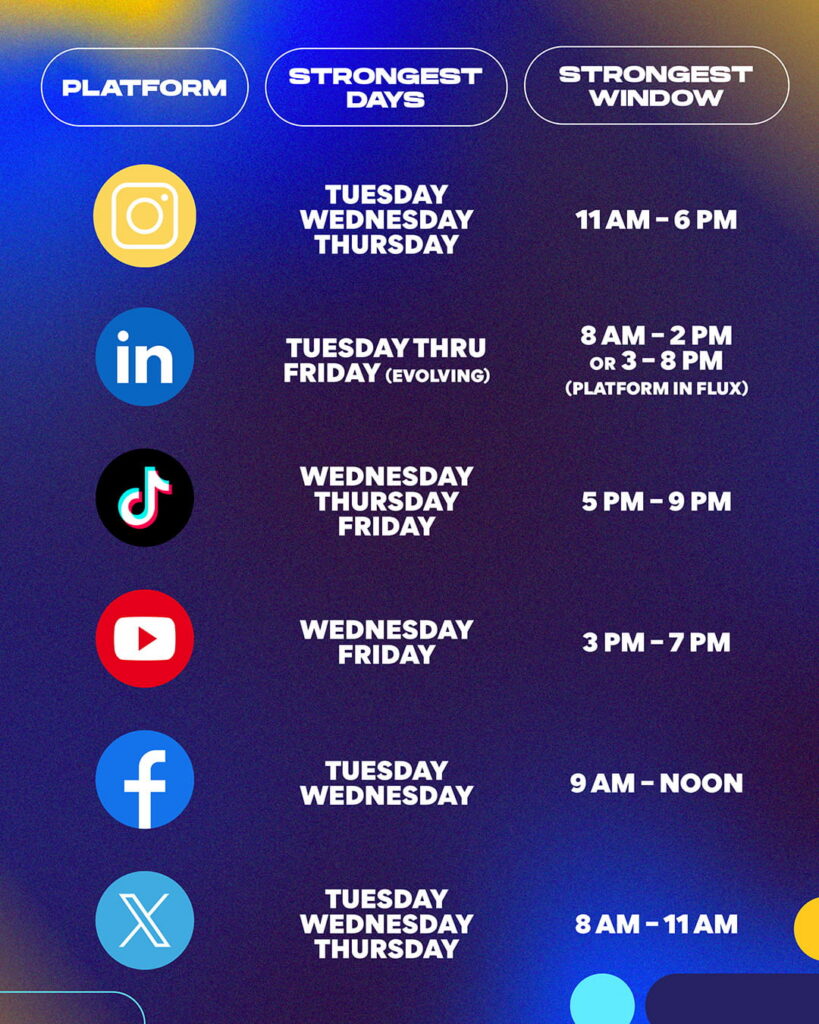
Best Times to Post: A Practical Framework
Every major platform’s timing data agrees on one foundational principle: your own audience analytics produce more accurate results than any published benchmark. Published benchmarks aggregate millions of accounts across industries, geographies, and audience types. Your audience is a specific subset with specific behavioral patterns.
That said, third-party benchmarks provide a useful starting point when you lack historical data or are launching on a new platform.
| Platform | Strongest Days | Strongest Window |
|---|---|---|
| Tuesday, Wednesday, Thursday | 11 AM – 6 PM | |
| Tuesday – Friday (evolving) | 8 AM – 2 PM or 3 – 8 PM (platform in flux) | |
| TikTok | Wednesday, Thursday, Friday | 5 PM – 9 PM |
| YouTube | Wednesday, Friday | 3 PM – 7 PM |
| Tuesday, Wednesday | 9 AM – Noon | |
| X (Twitter) | Tuesday, Wednesday, Thursday | 8 AM – 11 AM |
Use these as starting points. Run them for 30 to 60 days, track median performance by day and time, and adjust based on your data. Every platform provides native analytics that show when your followers are most active: Instagram Insights, LinkedIn Page Analytics, TikTok Studio, YouTube Analytics, and Facebook Insights all surface this data directly.
How to Extend Organic Reach Without Paying for Ads
The most common missed opportunity in organic social is treating distribution as the platform’s responsibility. The accounts that consistently outperform their baselines build distribution systems rather than waiting for the algorithm to do the work.
Instagram Collabs
Instagram’s Collabs 2.0 feature allows up to five accounts to co-author a single post, Reel, or carousel. Both accounts publish it simultaneously, combining both audiences into one distribution pool. Emplifi’s research on 1.15 million posts found Collab posts generate nearly double the impressions and engagement of solo posts.
The strategic application: co-publish event content with speakers, co-publish campaign content with corporate sponsors, co-publish partnership announcements with peer organizations. This requires no minimum follower count.
Employee and Member Advocacy
Content shared by employees, board members, or organizational advocates generates significantly more engagement than content shared through brand channels alone. Research compiled by EveryoneSocial cites studies showing 8 times more engagement and up to 561% greater reach from employee-shared content versus brand posts.
For nonprofits and associations, this extends to members and volunteers. Providing staff and supporters with pre-approved content they can personalize and share significantly expands organic reach. The key is making participation easy: short copy options, pre-sized graphics, suggested captions.
Black Digital builds social media toolkits as part of its content strategy work. See our guide on how to create a social media toolkit for the operational framework.
Partner Repost Kits (Toolkits)
A partner repost kit, or a social media toolkit, is a packaged collection of assets (suggested captions, pre-sized graphics, key hashtags, posting guidelines) distributed to sponsors, media partners, event speakers, or collaborating organizations. For campaigns, events, or major announcements, a coordinated partner amplification approach can multiply organic reach significantly without paid spend.
Tagging and Mentions
On LinkedIn, tagging a person notifies them directly and creates a prompt to engage. On Instagram, collaborative tags work similarly. On X, tagging organizations or individuals featured in your content creates a natural incentive for them to amplify your post. Every piece of content that features a person, organization, research source, or event partner is an opportunity for a relevant tag. Build this into content creation rather than treating it as an afterthought.
Community Management Timing
Engagement signals in the first 30 to 60 minutes after posting determine whether algorithms extend distribution to larger audiences. Concrete standards worth building into your process: respond to every comment within the first hour of posting, like every comment within 24 hours, and monitor replies actively during the first day a post is live. On LinkedIn, active comment threads allow posts to remain visible for two to three weeks. Posts without engagement die within hours.
Cross-Platform Repurposing
Repurposing is not cross-posting. Copy-pasting the same caption and image to every platform simultaneously undermines reach because each platform’s algorithm recognizes duplicate content and each platform’s audience has different content expectations.
Repurposing means taking the core idea and rebuilding it for each platform’s native format. A 20-minute webinar becomes a 60-second Reel on Instagram, a LinkedIn document post with the five key frameworks, a thread on X, and a YouTube Short. The audience gets the idea through the format they prefer on the platform they use. The algorithm gets original, native content rather than a recycled asset.
For a deeper look at how to build this production system, see our guide on 7 quick and effective social media marketing strategies for nonprofits.
Metrics That Matter More Than Likes and Views
Likes are the easiest metric to track and the least predictive of business outcomes. For marketing leaders building the case for social investment internally, the following metrics carry significantly more strategic weight.
Shares and Saves: These are the clearest behavioral signals of genuine content value. A share says the content was worth passing to someone else. A save says the content was worth returning to. Both are direct inputs into algorithmic amplification on every major platform.
Reach-to-Follower Ratio: Comparing accounts reached to total follower count reveals actual distribution efficiency. An account with 1,000 followers reaching 5,000 accounts per post is running a more effective organic program than an account with 10,000 followers reaching the same 5,000. This ratio is the baseline for measuring breakout performance.
Video Completion Rate: Average watch time as a percentage of total video length. Higher completion rates signal to algorithms that the content held attention. A practical benchmark: anything above 50% completion is performing well; above 75% is exceptional.
Comment Depth: A single thoughtful question generating a sustained back-and-forth thread is algorithmically more valuable than 50 generic one-word comments. Tracking quality and length of comment conversations, not just count, provides a better measure of genuine engagement.
Downstream Conversions: For mission-driven organizations, the most important metrics are event registrations, email list growth, donation interest form submissions, and consultation inquiries. These should be connected to social content via UTM parameters, landing page tracking, or CRM attribution wherever possible. For more on building this measurement system, see our guide on nonprofit website analytics.
Callout: Nonprofit-specific benchmark The M+R 2025 Benchmarks Study, drawing on 216 nonprofit participants, found TikTok audiences growing the fastest of any platform — an average 37 percent follower increase in 2024. For nonprofits in early-stage platform development, this represents a growth window that may not remain open indefinitely.
Common Mistakes That Undermine Organic Reach
The majority of organic reach problems can be prevented. The following are the most common and most consequential errors.
Posting external links in the body of posts.
Facebook, LinkedIn, Instagram, and X all suppress posts containing external links in the primary post text. Placing links in first comments extends post life, though even this workaround’s effectiveness varies. The stronger approach: deliver full value in the post itself.
Using engagement bait.
Facebook’s algorithm has penalized engagement bait since 2017 with increasingly sophisticated detection for react baiting, comment baiting, and tag baiting. LinkedIn’s algorithm targets “agree or disagree” posts and reaction polls specifically. Beyond the direct penalty to the offending post, repeated engagement bait can result in compounding suppression affecting all of an account’s content.
Cross-posting identical content.
Each platform’s algorithm detects duplicate content. More importantly, content calibrated for LinkedIn’s word-heavy format will underperform on Instagram’s visual environment. Platform-native adaptation pays back directly in reach.
Ignoring the first hour after posting.
The engagement velocity in the first 30 to 60 minutes after publishing is one of the primary signals platforms use to determine whether to extend distribution. Not monitoring and engaging during this window is the equivalent of leaving a campaign running with no one watching the results.
Excessive hashtags.
Adam Mosseri, head of Instagram, has confirmed multiple times that hashtags do not boost reach — they categorize content for the algorithm. Best practice across platforms is three to five relevant hashtags maximum. The larger shift is toward Social SEO — placing natural keywords in captions, alt text, and video transcripts rather than stacking hashtags.
Posting frequency errors.
On LinkedIn, posting more than once in a 24-hour window causes the newer post to absorb the older one’s distribution. Many organizations posting at high frequency are doing so at the direct expense of the per-post reach of each individual piece of content.
How to Build a Repeatable Reach Testing System
The organizations that produce consistently high-performing content test more systematically than those that do not.
Step 1: Establish your baseline.
Calculate the median view count, reach, and engagement rate for your last 30 posts on each active platform. Update this quarterly.
Step 2: Isolate one variable at a time.
When testing a specific format, posting time, caption length, or topic category, change one element at a time. Testing multiple variables simultaneously makes it impossible to identify what drove the change.
Step 3: Run each test for a minimum of four posts.
A single high-performing post may reflect timing, trending topics, or external amplification rather than the format itself. Four posts is the minimum to identify a pattern.
Step 4: Document what worked specifically.
Record not just that something performed well, but why: the format, the topic category, the hook structure, the first-comment approach, the tagging strategy, the posting time.
Step 5: Amplify before moving on.
When a post significantly outperforms its baseline, treat the window as an asset. Respond to every comment. Share the content in email, a newsletter, or a partner channel. A breakout post that gets no follow-through is a missed compounding opportunity.
Step 6: Define success before posting.
Every post should have a declared goal (awareness, engagement, traffic, conversion, growth) before it is published. This prevents the natural tendency to reframe weak posts as successes after the fact, which obscures the signal in your performance data.
Frequently Asked Questions
What makes a social media post go viral in 2026?
High-performing posts in 2026 earn outsized distribution by generating shares, saves, and watch time — the signals that algorithms across every major platform treat as the highest-value indicators of genuine content resonance. Viral reach is increasingly driven by algorithmic recommendation to new audiences rather than follower-to-follower sharing. The most reliable path to breakout performance: deliver complete value natively, target a specific audience, and actively manage engagement in the first hour after posting.
What is the best time to post on Instagram for nonprofits?
According to Sprout Social’s 2025 benchmark data drawn from nearly 2.7 billion engagements, Monday and Wednesday perform strongest for nonprofit Instagram accounts, with Wednesday at 5 PM as the peak window. However, Instagram Insights shows when your specific followers are most active, and that data should take precedence over any general benchmark.
How do you define “viral” for a small organization?
A post that reaches 10 to 20 times your median view or impression count qualifies as genuine breakout performance, regardless of the absolute number. A 500-follower account reaching 8,000 views has created something far more meaningful than a 100,000-follower account reaching the same number. Use Black Digital’s Viral Multiplier Framework — Mini (5–10x), Solid (10–20x), Breakout (20x+) — as your baseline.
What social media metrics matter more than likes and views?
Shares, saves, video completion rate, profile visits, email signups, event registrations, and downstream web conversions are all more predictive of business impact. Likes and total view counts are the easiest metrics to track and the least predictive of organizational outcomes. See how we measure social media performance for nonprofits and associations on our social media marketing services page.
How can nonprofits and associations increase organic reach without paid ads?
The highest-impact tactics are Instagram Collabs with partner organizations, employee and member advocacy programs with pre-packaged content, partner repost kits for campaigns and events, active community management in the first hour after posting, and platform-native repurposing of existing content rather than cross-posting identical assets across all channels.
Ready to Build a Social Media Strategy That Actually Produces Results
Black Digital works with nonprofits, associations, higher education institutions, and mission-driven organizations to build social media strategies that move beyond vanity metrics and toward measurable audience growth, engagement, and conversion.
If your organization is posting consistently without seeing measurable results, struggling to understand which platform is worth your team’s time, or producing content that performs well on some posts but cannot identify why, we can help you build a more systematic, outcomes-driven approach.
Schedule a free 30-minute social media strategy conversation. We will review your current content performance, identify what your specific audience responds to across platforms, and outline what a channel-aligned content strategy would look like for your organization.
Book a Free Strategy Session →