
Quick Overview
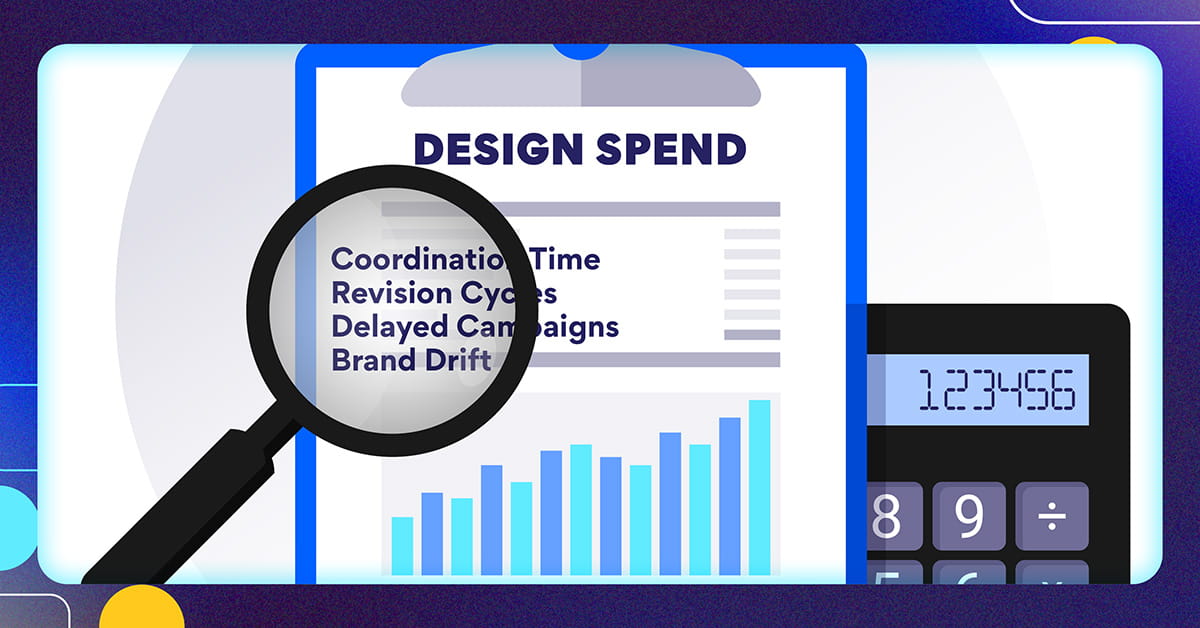
Most nonprofit and association communications teams know what they spend on design. Almost none know what that investment actually costs once revision cycles, approval delays, missed campaign windows, and brand inconsistency are factored in. The gap between the invoice and the true cost of disorganized creative operations is where budgets disappear, campaigns underperform, and leadership loses confidence in marketing as a business function. This article identifies where that cost accumulates, why it compounds, and what a governance-driven creative model does differently.
Why Your Creative Process Is Costing More Than Your Creative Budget
Your last campaign launched three weeks late. The fall fundraiser missed its optimal giving window. A board member asked why the homepage and the email looked like they came from two different organizations. And somehow, after all of that, the design line item in your budget looks perfectly reasonable.
The invoice is not the problem. The process is.
Most nonprofit and association communications teams are running creative operations that were never designed to scale. Work flows through whoever is available rather than whoever is right for the job. Approvals travel through email threads that branch unpredictably. Brand decisions get made in isolation, one deliverable at a time, by different people with different aesthetic instincts. The result is not just slower output: it is compounding organizational cost that never shows up in a line item.
Understanding where the real cost of creative disorganization lives is the first step to addressing it.
The Invoice Is the Smallest Part of What You Are Paying
When a nonprofit executive is asked how much the organization spends on design, they give a number. That number almost always reflects vendor invoices only.
It does not include the staff time consumed managing those vendors. It does not reflect the revenue impact of campaigns that launched two weeks late. It does not capture the long-term cost of a brand that looks fragmented across channels. And it has no line for the organizational credibility lost when a major donor sees three different visual identities in the same month.
Consider a typical mid-size nonprofit with a meaningful communications operation:
Vendor invoices: $2,500–$4,000 per month across design projects. This is the number that appears in the budget.
Coordination overhead: Communications staff spending 15–20 hours per month writing briefs, managing feedback threads, chasing timelines, and orienting new designers to brand standards. At a conservative $50/hour: well below the fully loaded cost of most nonprofit communications staff, that is $750–$1,000 per month that does not appear anywhere in the design budget.
Revision cycle drag: Multiple rounds of feedback that extend project timelines by one to three weeks per deliverable. For a team producing eight to twelve deliverables per month, this adds up to hundreds of hours of elapsed time annually: time during which campaigns are delayed and opportunities close.
Missed windows: The fall campaign that should have launched September 15 and went live October 7. The giving day push that was not ready until three days after peak traffic. The conference materials that arrived the day of the event. Each of these represents foregone performance that never appears in a post-mortem as a design cost.
Brand inconsistency: Different designers interpret brand guidelines differently. The email looks one way. The social graphics look another. The landing page uses a slightly different palette. Over time, this creates what brand strategists call brand drift. a gradual divergence from a coherent identity that erodes the trust and recognition that make marketing work.
The organizations that address this problem are not necessarily spending less on creative work. They are spending differently: with more of the investment going toward strategy and governance, and less absorbed by process friction.
Where the Process Breaks Down
Creative operations fail at predictable points. Identifying which ones are active in your organization is more useful than a general diagnosis of “our design process needs improvement.”
The Brief Problem
Most design work starts with an informal request. An email. A Slack message. A conversation that ends with “just make it look good.” The designer interprets the brief they were not given, produces something that reflects their interpretation, and the revision cycles begin, not because anyone made a mistake, but because the brief never existed.
A clear creative brief answers seven questions: what problem is being solved, who the audience is, what success looks like, what brand constraints apply, what tone is appropriate, when it needs to ship, and what files or specs are required. Organizations that brief consistently reduce revision rounds from four to six cycles down to one to two. That reduction alone changes the economics of every project.
The Approval Problem
Who decides when creative work is done? In most nonprofits, the answer is unclear. The communications director has input. The program lead has input. The executive director has a strong opinion about the logo. The development team wants to see anything donor-facing. The result is design by committee, which produces work that offends no one and moves no one.
The governance standard that consistently produces faster, better outcomes is a single point of final approval: one person who synthesizes stakeholder input and makes the call. The label is operational clarity, not authoritarianism. The difference in production timelines (days versus weeks) is not marginal.
The Consistency Problem
Brand consistency builds organizational credibility.
Research consistently shows that brand consistency across channels builds the recognition and trust that drive donor behavior, membership growth, and program enrollment. When a potential major donor encounters three visual identities in the same month: one from an email, one from a social post, one from a program flyer. the subtext is not “we are a diverse team.” It is “we are not organized enough to present ourselves coherently.”
For associations selling membership and nonprofits cultivating multi-year donor relationships, brand inconsistency is a slow-moving credibility problem. It rarely shows up as a direct causal factor in a declined gift or a lapsed member. It accumulates in background impressions that shape whether an audience develops confidence in the organization.
The Knowledge Loss Problem
Every time a design relationship ends. a freelancer moves on, a contract expires, a staff designer departs: institutional knowledge leaves with them. Template files live on their machine. The rationale for brand decisions lives in their memory. The next person starts over.
Organizations without documented design systems rebuild their visual identity infrastructure repeatedly, at significant cost in both money and organizational time. A design system (documented brand standards, reusable templates, component libraries, and decision rationale) is infrastructure, not overhead. Building it once and maintaining it continuously costs far less than rebuilding it every 18 months.
What Creative Governance Actually Means
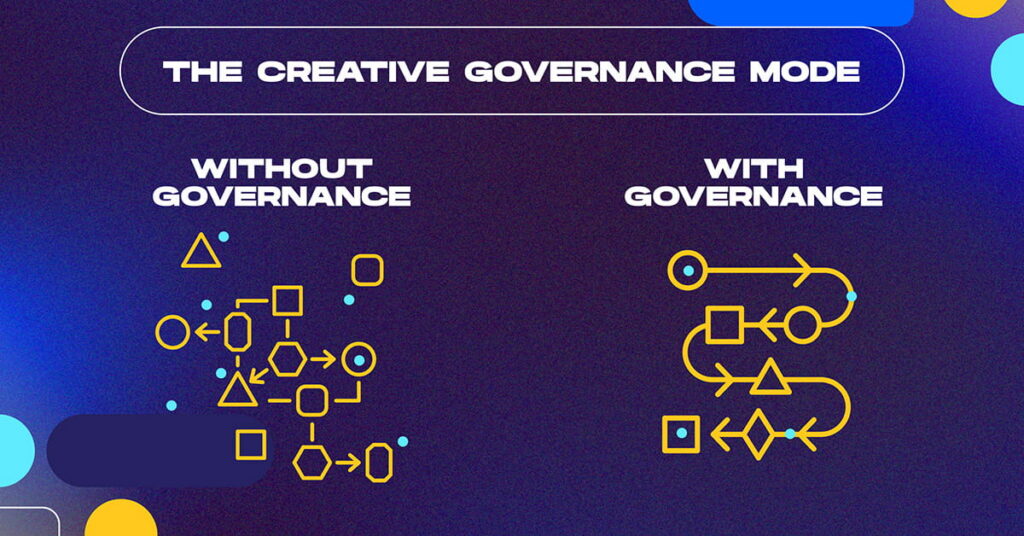
“Creative governance” sounds like a management concept. In practice, it is the set of operational structures that answer three questions: who decides, how does work get briefed, and where do assets live.
Organizations that have solved their creative operations problem share these characteristics:
Documented creative briefs as standard practice.
Every design request, regardless of size, starts with a written brief. The brief is not a form for its own sake: it is the tool that eliminates ambiguity before production begins. When a designer has a clear brief, they can produce an accurate first draft rather than a starting-point guess.
A single approval authority.
One person owns final creative decisions. They collect input, synthesize it, and decide. This is usually the Director of Communications or a senior creative lead. Their role is to protect both quality and timeline by keeping approval from becoming a negotiation.
A living design system.
Templates, brand standards, component libraries, and asset archives are maintained in a shared, accessible location. New work does not start from scratch: it starts from the established system. This reduces both production time and brand drift simultaneously.
Defined capacity and scope.
Creative teams (whether internal, agency, or hybrid) work within documented scope. What is included in a given retainer or engagement, what requires a change request, and what rolls to the next cycle is agreed upon before work begins. Scope ambiguity is where timelines and budgets go to die.
Predictable production cycles.
Work is batched where possible. Campaigns are planned with enough lead time for proper creative development. “Urgent” requests are identified as such explicitly rather than by default, which requires that non-urgent requests be handled before they become urgent.
These structures do not require expensive tooling or a large team. They require intentional design of how creative work flows through an organization.
What This Looks Like in Practice
A professional association with an eight-person communications team produces a bimonthly magazine, a weekly email newsletter, event marketing for four conferences per year, and a continuous stream of social and digital content.
Without governance structures, this team spends a significant portion of its capacity managing creative process rather than producing creative work. Brand guidelines exist but are inconsistently applied. The magazine and email newsletter look like they come from related but distinct organizations. Conference materials are always late because they compete with everything else in the last two weeks of the cycle.
With governance structures in place. a standard brief template, a single approval lead, a shared asset library, and a documented production calendar. the same team produces more, produces it faster, and produces it with a consistent visual identity. The magazine and email reflect a unified brand. Conference materials ship two weeks before the event. The brief template eliminates an average of two revision rounds per project.
The investment required to build this system is a few weeks of operational work. The compounding return is measured in campaign performance, reduced revision overhead, and a brand that builds recognition over time rather than resetting with each new designer.
When an Agency Partner Changes the Equation
Some organizations have the internal capacity to build and maintain creative governance systems. Many do not. Communications teams are stretched across multiple functions, turnover is frequent, and the expertise required to build brand systems and operational infrastructure is different from the expertise required to execute daily communications work.
An agency creative partner changes the operational equation in several ways.
The system already exists.
A professional agency brings established creative governance processes, brief templates, approval workflows, and brand documentation systems. Organizations do not need to build these from scratch: they inherit a functional infrastructure.
Strategic depth alongside execution.
The difference between a freelance designer and an agency creative partner is the same as the difference between a contractor and an architect. One builds what you specify. The other helps you figure out what to specify, and why. For organizations navigating a rebrand, a campaign, a website redesign, or a shift in audience positioning, the strategic layer matters.
Capacity without overhead.
Agency relationships provide access to design, copywriting, strategy, and production resources without the overhead of full-time employment: benefits, equipment, management time, training investment. For organizations whose design needs fluctuate by campaign cycle or season, this flexibility is operationally significant.
Continuity without dependency.
When an agency relationship is structured correctly, institutional knowledge lives in the agency’s documentation, not in any individual’s head. Brand standards, design decisions, and project history are portable and accessible regardless of personnel changes on either side.
Black Digital works with nonprofits, associations, higher education institutions, and government agencies as a strategic creative partner: providing brand strategy, design governance, creative execution, and the operational infrastructure that makes creative work predictable rather than reactive.
The Diagnostic: Where Is Your Creative Process Breaking Down?
Before making any structural change, it helps to diagnose where the cost is actually accumulating. The following questions identify the highest-leverage improvement opportunities:
- How long does a typical design deliverable take from request to approval? If the answer is more than two weeks for standard assets, brief clarity or approval structure is the bottleneck.
- How many revision rounds does a typical project require? More than two rounds on standard deliverables signals a brief problem or an approval structure problem.
- Can any team member answer immediately: who has final approval on this design? If the answer requires deliberation, you have a governance gap.
- Do your email, social, website, and print materials look like they come from one organization? If the answer is “mostly” or “it depends,” you have a consistency problem that is likely affecting audience trust.
- When a designer leaves or a contract ends, how long does it take a new person to become productive on your brand? More than two weeks signals an absent or underdocumented design system.
Organizations that identify problems in two or more of these areas are carrying a meaningful creative operations cost that is not visible in their budget.
Frequently Asked Questions
Why does nonprofit design work take so long?
The most common causes are: unclear briefs that require multiple revision cycles to resolve, undefined approval authority that routes work through multiple stakeholders without a final decision-maker, and insufficient lead time that compresses production into an emergency timeline. These are process problems, not capacity problems. Adding more design resources to a broken process produces more volume of the same delays, not faster delivery.
What is creative governance?
Creative governance is the operational framework that answers three questions for every design project: who decides, how does work get briefed, and where do assets live. It includes brief templates, single-approver authority structures, shared asset libraries, and documented design systems. Organizations with effective creative governance produce more, produce it faster, and maintain stronger brand consistency than those without it.
How does brand inconsistency affect nonprofit donor trust?
Brand consistency builds the recognition and credibility that determine whether donors, members, and funders develop confidence in an organization over time. When a prospective donor encounters different visual identities across touchpoints, the implicit signal is disorganization: regardless of the quality of the work those communications describe. For organizations building multi-year donor relationships or association memberships, this credibility erosion is a slow-moving risk that rarely shows up as a direct cause of lost revenue but consistently shapes outcome probabilities.
When should a nonprofit hire a creative agency versus a freelancer?
A freelancer is appropriate for well-defined, execution-level work where the brief is clear, the brand system exists, and the project does not require strategic input. An agency is appropriate when the organization needs strategic creative leadership alongside execution, when a rebrand, a campaign strategy, a website redesign, or a brand governance system is required, not just production capacity. The other signal: if a nonprofit is spending significant staff time managing freelancers, coordinating feedback, and maintaining brand consistency across multiple vendors, the coordination cost alone often exceeds the premium of an agency relationship.
What does a creative agency retainer include for nonprofits?
A well-structured creative retainer includes defined monthly capacity (design, strategy, copywriting, or production as scoped), a documented deliverable list, clear revision standards, an approval workflow, access to the agency’s brand documentation and asset management systems, and regular reporting that connects creative output to organizational goals. What it does not include, and should not include under a retainer: is open-ended scope, unlimited revisions, and undefined change request processes. The boundary between retainer scope and change requests is where most agency-client creative relationships break down.
Ready to Build a Creative Operation That Performs
Black Digital works with nonprofits, associations, higher education institutions, and mission-driven organizations as a full creative partner: from brand strategy and governance systems to design execution and campaign production.
If your organization is producing creative work through a process that consistently produces late deliverables, multiple revision rounds, and visual inconsistency across channels, the cause is an absence of operational infrastructure, not a failure of team effort.
Schedule a 30-minute creative strategy conversation. We will assess your current creative process, identify where the highest-cost friction points are, and outline what a governance-driven creative partnership would look like for your organization.